What are MMBILL.COM charges on bank statement?

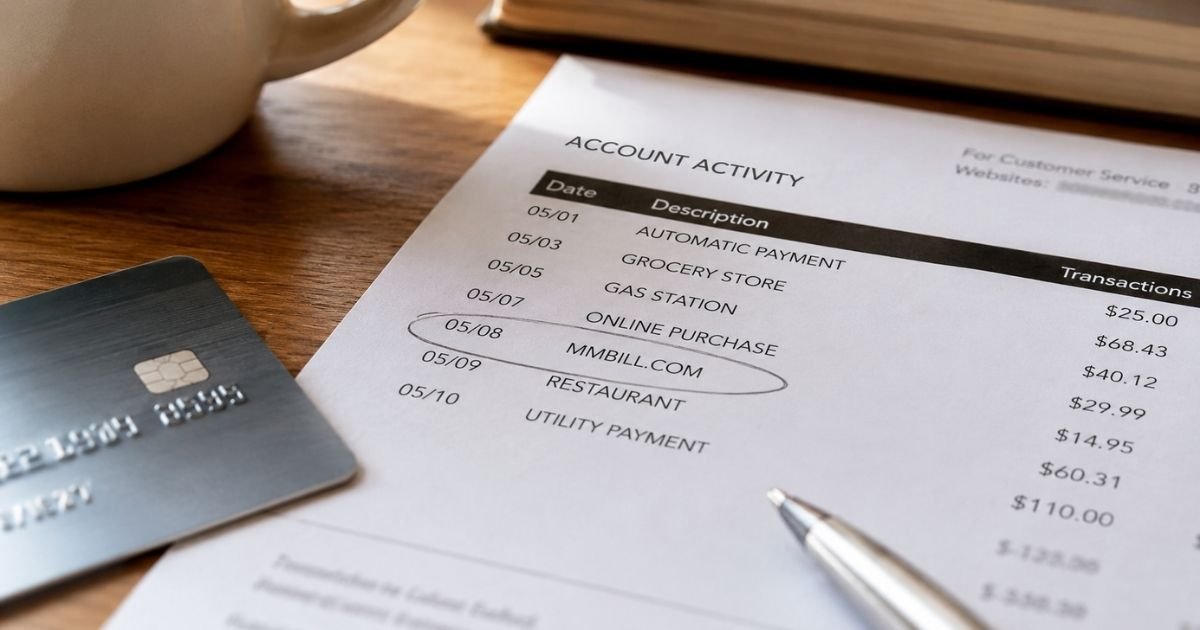
You open your statement and see MMBILL.COM. The name does not match a store you remember. That moment is common, and it is usually solvable.
This guide explains what the label typically means, how to match it to a real purchase, and what to do next. Stay calm and check the facts before you dispute anything.
What MMBILL.COM Means on Your Bank Statement
MMBILL.COM is generally a billing descriptor, not the brand name of the site you used. A billing descriptor is the short text your bank prints to identify a merchant.
MMBILL typically processes card and check payments for online sites. When a site uses that processor, your statement may show MMBILL.COM instead of the website name.
The company’s own support pages say you may be billed discreetly under mmbill.com. That is why the line item can look generic even when the charge is real.
Why the Name Looks Unfamiliar
Banks and card networks limit how many characters a merchant can print. Processors often use a short house name so many different sites can bill under one label.
Some merchants also choose a discreet descriptor on purpose. That is especially common with adult sites, dating platforms, and other digital memberships.
So you may have paid a site you recognize. The statement just used the processor’s name instead of that site’s brand.
How MMBILL.COM Usually Appears
The exact text can vary by bank, card network, and checkout path. You may see a close match rather than the same wording every time.
Common variations reported by cardholders include:
| Statement text you may see | What it often is |
|---|---|
| MMBILL.COM | Standard processor descriptor |
| MMBILL | Shortened version of the same label |
| MB * MMBILL.COM | Processor prefix plus domain |
| MMBILL EU MALTA | Same processor with a location tag |
| CHKCARD MMBILL.COM | Debit or check-card wording from your bank |
| POS PURCHASE MMBILL.COM | Point-of-sale style wording from your issuer |
| MMBILL COM plus a phone number | Descriptor with a support number attached |
Your bank may also add words like PENDING, PRE-AUTH, POS DEBIT, or REFUND. Those extra words usually come from your issuer, not from a second company.
Match the date and the dollar amount first. The wording alone is rarely enough.
What These Charges Are Typically For
MMBILL.COM most often appears after an online purchase or a recurring membership. It is not typically a bank fee, an ATM fee, or a government tax.
Consumer reports most often tie the descriptor to adult live-cam and token sites, especially Chaturbate. That site’s checkout has been described as showing mmbill.com or a similar billing name.
Other digital merchants may use the same processor. Dating sites, membership content, and other subscription offers are commonly mentioned in charge-lookup reports. Do not assume every MMBILL.COM charge on bank statement is the same merchant.
A one-time token or credit pack can post once. A membership or “supporter” plan may post again on a cycle. If the amount repeats on a similar date, you likely have a recurring plan.
Typical amounts vary by merchant and package. Public reports often mention figures around the high teens to about $20 for a monthly plan, plus larger one-time token buys. Your amount may differ.
How to Identify Your Specific Charge
Start with your own records before you call anyone.
Look at the date, the exact amount, and whether the charge is pending or posted. Then search your email for that date using words like receipt, tokens, membership, or the dollar amount.
Check the card you actually used. A forgotten prepaid card, a family card, or a digital wallet can hide the original checkout.
Log in to sites you used around that date. Look for purchase history, token history, or a membership tab. On some adult platforms, a membership can keep billing even if you have not visited in weeks.
The processor’s support site also points you to an account information form if you no longer have the receipt. You can use that path, or you can call the number printed with the charge if your statement includes one.
Official support pages for mmbill.com list a U.S. and Canada toll-free number of 1 (877) 338-7047 and an international number of +1 (954) 504-9590. Confirm any number on the live site or on your own statement before you call.
Have the last four digits of your card, the charge date, and the amount ready. A support agent can usually tell you which merchant account created the bill.
How to Stop Future MMBILL.COM Charges
Cancel at the merchant first when you can. The processor bills on behalf of the site. Ending the plan on that site is the cleanest way to stop the next draft.
Look for Account, Membership, Tokens, or Billing. Turn off auto-renew and save a screenshot or email confirmation.
If you cannot log in, use the site’s password reset with the email you used at signup. Check spam folders for old welcome or receipt messages.
If you still cannot reach the merchant, contact MMBILL support and ask them to identify the account and stop future billing. Ask what they can and cannot cancel. Policies vary.
Then watch the next statement. A charge already in process may still post after you cancel. That lag is common with card billing.
If the same amount returns after you cancel, call your bank. Ask about a merchant block or a card replacement. Do not assume a verbal cancel is enough until the next cycle is clean.
What to Do If You Do Not Recognize the Charge
An unrecognized line is not automatically fraud. It may be a forgotten trial, a family member’s purchase, or a site you used once and never opened again.
Still treat it seriously. Write down the date, amount, and full descriptor. Note whether similar charges appear in prior months.
If you did not authorize it, call your bank or card issuer promptly. Ask about a dispute or unauthorized-use claim. Time limits apply, and they can vary by issuer.
Your issuer may ask if you shared the card, saved it in a browser, or used it on a public device. Answer honestly. That helps them route the case.
You can also ask the issuer to decline future charges from that merchant descriptor. Results vary. Some blocks work. Others miss a slightly different wording.
If fraud is confirmed, ask whether you should replace the card. That is often the safest step when the card number may have been stored.
Do not send card numbers by email to an unsolicited contact. Use the number on your card, your banking app, or the official mmbill.com support page.
How to Keep These Surprises Off Future Statements
Review new card charges every few days, not just at month-end. Pending charges are easier to catch early.
Turn on issuer alerts for amounts over a limit you choose. A $15 or $20 alert catches many membership drafts.
Use virtual card numbers when your bank offers them for one-off sites. You can shut that number off without closing your main card.
Keep a simple list of paid apps, tokens, and memberships. Include the email used at signup. That list saves time when a descriptor looks odd.
Read the checkout box before you buy credits. Some sites add a recurring supporter fee after a first token pack. The fine print is easy to miss on a phone screen.
FAQs About MMBILL.COM Charges on Bank Statement
Q. Is MMBILL.COM a scam?
A. MMBILL.COM is generally a real billing descriptor used by a payment processor, not a fake bank fee. Many charges are tied to real online purchases. Unauthorized use can still happen, so verify any line you do not recall.
Q. How do I find which website billed me through MMBILL.COM?
A. Match the date and amount to your email receipts and site purchase histories. If that fails, call the processor support number on mmbill.com or on your statement and ask which merchant account created the charge.
Q. Can I get a refund for an MMBILL.COM charge?
A. Refunds depend on the merchant’s rules and on your card issuer’s dispute process. The processor does not automatically reverse every charge. Ask the original site first, then your bank if you still disagree.
Q. Will MMBILL.COM keep charging me every month?
A. It may, if the original site set up a membership or auto-renew plan. A one-time token buy should not repeat. Check the merchant account for active plans and confirm the next statement after you cancel.
Conclusion
MMBILL.COM on your bank statement usually means a payment processor billed your card for an online site. The label is often discreet, so the brand you remember may not appear.
Match the date and amount, cancel any plan you no longer want, and use official support or your bank if the charge is wrong. A quick review now can stop the next surprise draft.
Disclaimer
This article is for general information only. It is not financial, legal, or tax advice. Billing descriptors, refund rules, and dispute rights vary by merchant and by card issuer. Confirm account-specific questions with the company that billed you or with your bank before you act.