Is TLT a Good Investment Now?

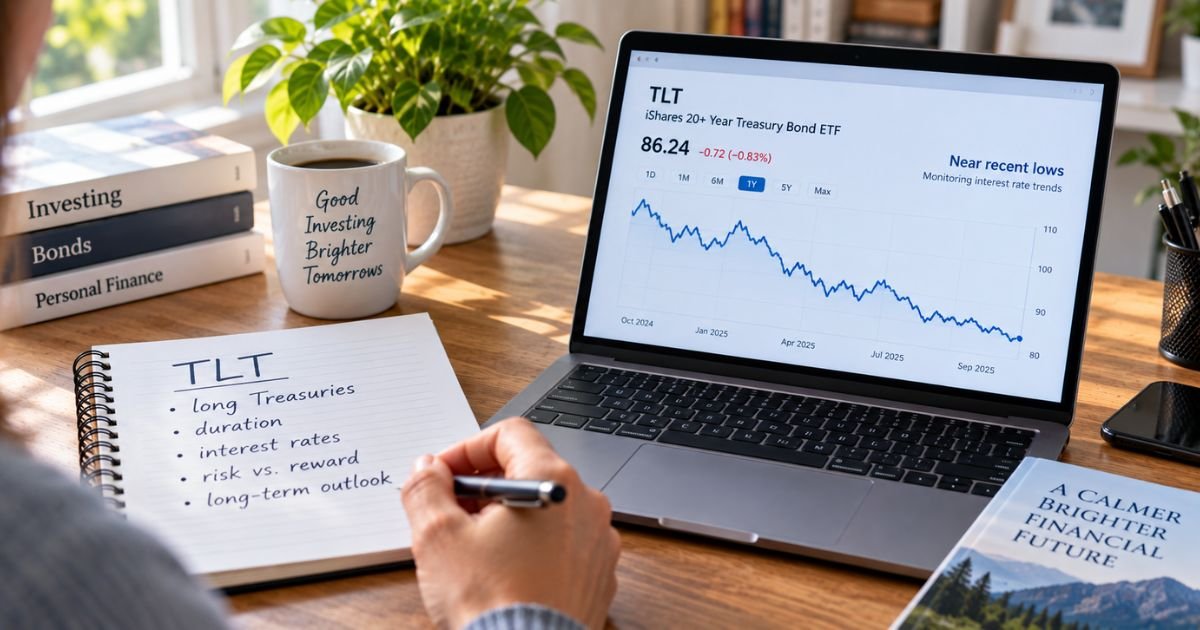
TLT is easy to buy and hard to judge. It looks “safe” because it holds U.S. Treasuries. Its price can still swing like a risk asset when long-term rates move.
As of mid-September 2026, TLT sits near the low end of its 52-week range, around $81. The income is higher than it was when yields were near 1%.
The rate path is still unsettled. That mix is why “is TLT a good investment now” has no one-word answer.
What Is TLT?
TLT is the iShares 20+ Year Treasury Bond ETF. It seeks to track U.S. Treasury bonds with remaining maturities greater than 20 years. BlackRock’s iShares site lists the ICE U.S. Treasury 20+ Year Bond Index as the benchmark.
The fund launched on July 22, 2002. It trades on Nasdaq under the ticker TLT. It pays distributions monthly. The prospectus expense ratio is 0.15%.
As of September 14, 2026, iShares reported net assets of about $47.7 billion and a NAV of $80.92. The closing market price that day was $80.93. Holdings numbered 47. Almost all assets sit in Treasuries, not company bonds.
That last point matters. TLT generally has very low default risk. The U.S. government can pay these bonds in dollars. Price risk is a different story. Long bonds fall when long-term yields rise. They rally when those yields fall.
Key TLT Numbers to Know Right Now
Figures move every trading day. Use these as a snapshot from mid-September 2026, not a promise.
| Item | Recent reading | Why it matters |
|---|---|---|
| Price / NAV | About $80.93 / $80.92 on Sep. 14, 2026 | Near the 52-week low area |
| 52-week range | About $80.46 to $92.19 | Shows a wide one-year swing |
| 30-day SEC yield | 5.29% as of Sep. 11, 2026 | A standardized income snapshot |
| 12-month trailing yield | 4.81% as of Sep. 11, 2026 | What recent payouts added up to |
| Average yield to maturity | 5.41% as of Sep. 11, 2026 | Rough income if bonds are held conceptually to maturity inside the fund |
| Effective duration | About 15 years as of Sep. 11, 2026 | A 1-point yield rise can mean a large price drop |
| Weighted average maturity | About 26 years | These are long bonds |
| YTD NAV total return | About -4.47% as of Sep. 11, 2026 | Income did not fully offset price losses year to date |
Sources: iShares / BlackRock product pages as of those dates. Yields and duration change as bonds roll and rates move.
A simple duration rule of thumb: if long-term yields rise by 1 percentage point, a fund with 15-year duration may fall about 15% in price, all else equal. If yields fall by 1 point, the price may rise by a similar amount. That is an estimate, not a guarantee.
Why TLT Is Down Even With a Higher Yield
Bond prices and yields move in opposite directions. When the 20-year and 30-year Treasury yields climb, older long bonds look less attractive. TLT marks those bonds to market every day.
In mid-September 2026, the 10-year Treasury yield was reported near 5.03%, its highest level since 2007 in one widely cited market update. The 20-year yield was reported around 5.4%. The 30-year yield was near 5.38%.
That backdrop is tough for TLT’s price. You still collect monthly interest. If the price falls faster than the income arrives, your total return can be negative. That is what many holders have seen over the past year.
The Fed’s next policy meeting was also in focus the same week. Futures pricing cited in market coverage pointed to a high chance of a quarter-point hike, with inflation still above the Fed’s 2% target.
Short-term policy is not the same as the 20-year yield. Long yields also react to inflation expectations, Treasury supply, and how much extra return investors demand to lock money up for decades.
Past calendar years show the same sensitivity. iShares’ mid-2026 fact sheet listed a 2022 NAV return of about -31%. Later years were mixed. Past performance does not tell you what happens next. It does show that “Treasury” does not mean “steady price.”
When TLT Can Make Sense
TLT can fit a plan if you understand it as a long-rate tool, not a savings account.
You want a higher starting yield than the 2020–2021 era.
New money in TLT now begins with a much higher yield than when long Treasuries paid near 1% to 2%. Income is a larger part of the return math than it was then.
You can hold through large price swings.
Duration near 15 years means a bad rate year can wipe out several years of coupons in the price.
You want a hedge if growth slows and long yields fall.
Long Treasuries have sometimes rallied when investors flee risk. That hedge is not automatic. Inflation scares can send stocks and long bonds down together.
You want Treasury credit quality in one ticker.
TLT is liquid. Average volume is often tens of millions of shares. You can buy or sell during market hours like a stock.
You prefer monthly cash flow.
Distributions are generally interest from Treasuries. Treasury interest is typically taxable on your federal return and often exempt from state income tax. Confirm that with a tax pro. Rules depend on your state and account type.
TLT is usually a weaker fit if you need the money in a year or two. It is also a weaker fit if a 10% to 20% price drop would force you to sell.
The Main Risks Right Now
Interest-rate risk is the big one.
If long yields keep rising from already high levels, TLT’s price can fall further even while the SEC yield looks appealing.
Inflation risk.
Unexpected inflation tends to hurt long bonds. You get paid in dollars that buy less, and yields may rise to compensate.
Duration is reset, not locked.
TLT is not a single bond you hold to 2046. The ETF keeps a long-maturity basket. You do not automatically “wait it out” the way you can with one Treasury held to maturity in a brokerage account.
Fiscal and supply pressure.
Heavy Treasury issuance can add extra yield at the long end. That term premium can stay high even if the Fed later cuts short-term rates.
Opportunity cost.
Short Treasury bills and short-term bond ETFs have paid income with far smaller price swings in recent years. You may earn less upside if long yields crash. You also take less damage if they do not.
Credit-rating headlines.
Treasuries still sit at the top of most credit scales. Rating debates can still move sentiment and the long end of the curve. Do not confuse a headline with a missed coupon.
None of these risks mean TLT is a scam. They mean the word “safe” is incomplete.
How TLT Compares With Simpler Choices
You do not have to choose only TLT or only cash. Many people split the job.
| Fund idea | Typical role | Rate sensitivity |
|---|---|---|
| TLT | Long Treasury rates and monthly income | Very high |
| IEF (7–10 year Treasuries) | Intermediate Treasuries | Moderate |
| SHY or similar 1–3 year Treasuries | Short bonds | Low |
| SGOV, BIL, or T-bills | Cash-like Treasury bills | Very low |
| A single 20- or 30-year Treasury note or bond | One maturity you can hold to the end | High, but you can hold to par if you wait |
Shorter funds usually lose less when yields rise. They also gain less when yields fall. TLT is the louder instrument.
If you already own a target-date fund or a total bond market fund, you may already have some Treasuries. Adding a large TLT sleeve stacks more long-duration risk on top.
A Practical Way to Decide
Skip the hot take. Use a short checklist.
- Write the job. Is this income, a rate hedge, or a bet that long yields will drop?
- Measure the pain. Could you watch TLT fall 15% and still hold?
- Size the position. A 3% to 10% sleeve behaves differently than “most of my bond money.”
- Pick the account. Interest is often more tax-efficient in a tax-advantaged account. Your situation may vary.
- Set a review date. Recheck duration and your reason after the next inflation reports, not after every tick.
If you cannot name the job in one sentence, TLT is probably too sharp for that cash.
Do not buy TLT only because the chart looks “cheap.” A 52-week low can be an entry. It can also be a trend. Cheap versus 2020 is not the same as cheap versus the next move in the 30-year yield.
FAQs About Is TLT a Good Investment Now
Q. Is TLT a good investment now?
A. It depends on your time horizon and your view on long-term yields. TLT now offers a much higher starting yield than in the early 2020s, with 30-day SEC yield recently near 5.3%. Duration near 15 years still makes the price very sensitive if long rates rise from here. It is not a good stand-in for cash.
Q. Does TLT pay dividends every month?
A. TLT typically distributes income monthly. Recent monthly amounts have been in the low-$0.30s per share range, and they change. The 12-month trailing yield was about 4.81% as of September 11, 2026 on iShares data. Treat payouts as variable bond interest, not a fixed coupon from the ETF itself.
Q. Why did TLT fall if Treasuries are “safe”?
A. “Safe” here usually means low default risk, not a stable price. TLT holds very long bonds. When the 10-year and 30-year yields jumped toward multi-year highs in September 2026, existing long-bond prices dropped. The monthly income did not always cover that price decline.
Q. Is TLT better than buying a Treasury bond myself?
A. TLT is simpler and stays long-duration on purpose. A single Treasury lets you hold to maturity and collect par if you wait, assuming no sale. TLT will keep replacing bonds to stay in the 20-year-plus lane. Choose TLT for a tradable long-rate package. Choose individual bonds if holding to a date is the whole plan.
Conclusion
TLT is a liquid way to own long U.S. Treasuries, not a CD. In September 2026 it combines a higher yield with a price already pressured by long-term rates near multi-year highs.
It may help you if you can hold through sharp drawdowns and you want income plus a stake in falling long yields.
It may hurt you if you need stable principal or you are using it as a parking place for cash. Match the ETF to that job before you buy.
Disclaimer
This article is for general information only. It is not financial, tax, or investment advice and is not a recommendation to buy or sell TLT or any other security. Yields, duration, Fed policy, and prices change. Past performance does not guarantee future results. Policies and tax treatment vary. Verify current fund data on the iShares prospectus and fact sheet, and speak with a qualified advisor about your own situation.