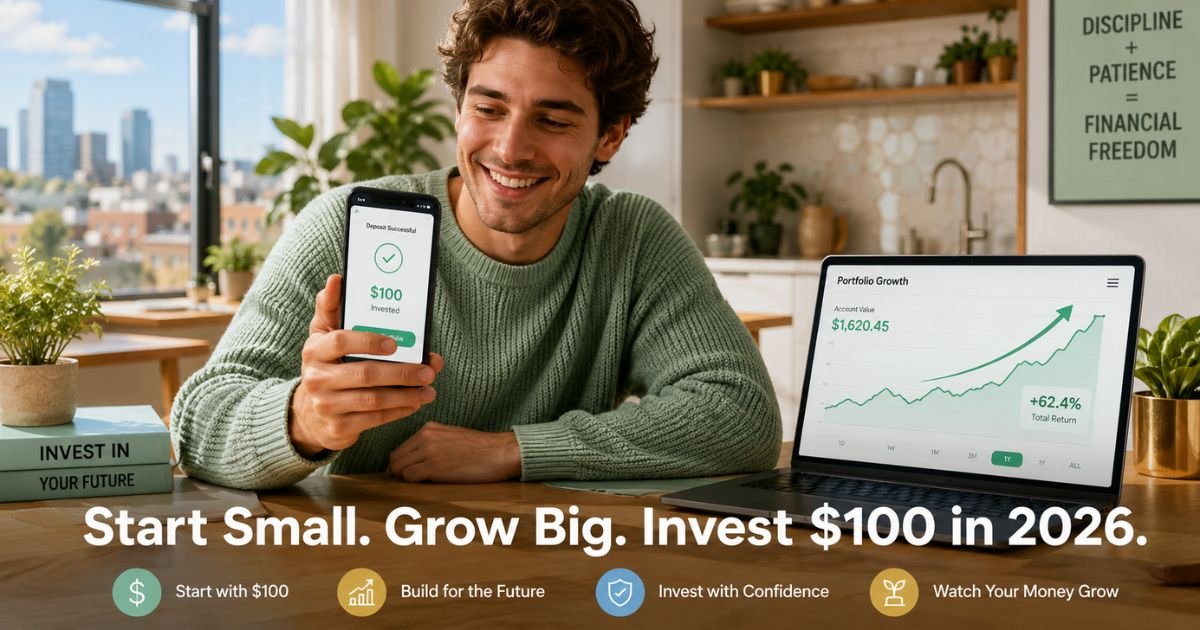
Have you ever stared at your bank app and wondered if that $100 could actually do something useful? You are not alone. In 2026, starting small is not just possible. It is smart, accessible, and one of the best financial moves you can make right now.
The barriers that once kept regular people out of the stock market have almost disappeared. Zero-commission trading, fractional shares, and beginner-friendly apps mean your first $100 can buy real pieces of top companies today. Let’s walk through exactly how to start investing with $100 in 2026 without feeling overwhelmed.
Why Starting with Just $100 in 2026 Makes Perfect Sense
Time in the market beats perfect timing every single time. Even a small amount invested early can grow dramatically thanks to compound interest. Many successful investors today began with far less than what most people spend on coffee in a week.
In 2026, apps and brokers have made it easier than ever. You no longer need thousands of dollars or a finance degree. You just need the willingness to begin and a little patience. The question is not whether you can afford to start. The real question is whether you can afford to wait.
Preparing Your Finances Before You Invest a Dime
Before you move that $100 into the market, take a quick look at your foundation. Investing works best when it sits on top of smart money habits.
- Build a starter emergency fund of at least $1,000 in a high-yield savings account first if you do not have one yet.
- Pay off any high-interest credit card debt (above 8-10%) before investing aggressively.
- Make sure you have steady income and a basic budget so new contributions feel sustainable.
These steps protect you from needing to sell investments at the wrong time. Once those basics feel solid, your $100 becomes true investment money instead of money you might need next month.
Choosing the Right Platform to Start Investing with $100 in 2026
Picking the right app matters more than most beginners realize. You want zero or very low minimums, fractional shares, and strong educational tools.
Here are three standout options in 2026 that welcome small accounts:
Fidelity stands out as a top choice for most beginners. It offers $0 minimums, excellent research, and Fidelity Go (its robo-advisor) stays completely free for balances under $25,000. Many people love how clean and trustworthy the platform feels.
Robinhood appeals to those who want a super simple mobile experience. It supports fractional shares, occasional IRA contribution matches, and quick deposits. The interface feels modern and non-intimidating.
Charles Schwab delivers robust tools and outstanding customer support. Its $0 minimums and fractional shares make it easy to start small while still giving you room to grow later.
Other solid mentions include Public.com for its social features and cash yield on uninvested money, plus M1 Finance if you like building custom portfolios over time. Compare a couple and pick the one whose app you actually enjoy opening.
Best Ways to Put Your $100 to Work
With only $100, diversification is everything. Avoid putting it all into one hot stock or meme coin. Instead, focus on low-cost, broad-market options that have historically delivered strong long-term results.
Broad index ETFs remain the smartest choice for most people starting small. Consider funds like:
- VOO (Vanguard S&P 500 ETF) – tracks 500 of America’s largest companies
- VTI (Vanguard Total Stock Market ETF) – gives you the entire U.S. stock market in one fund
- SCHD (Schwab U.S. Dividend Equity ETF) – focuses on quality companies that pay dividends
These options carry low expense ratios (often 0.03% or less), so more of your money stays working for you. In 2026, fractional shares mean your full $100 gets invested immediately instead of sitting in cash waiting for a full share price.
Robo-advisors like Fidelity Go can automatically build and manage a diversified portfolio for you based on your goals and risk tolerance. For many new investors, this hands-off approach removes the guesswork and emotion.
Your Step-by-Step Plan to Start Investing with $100 Today
Ready to take action? Follow these simple steps and you could have your money working within the next 30 minutes.
- Download your chosen app and complete the quick account opening process (usually takes 5-10 minutes with your ID ready).
- Link your bank account and transfer your $100 (most platforms allow instant or same-day funding).
- Decide between a taxable brokerage account or a Roth IRA if you have earned income and want tax advantages.
- Search for a broad ETF such as VOO or VTI and purchase as many fractional shares as your $100 allows.
- Turn on any available round-up or recurring investment features so future small amounts keep growing your position.
- Set a calendar reminder to check your account once per quarter instead of daily.
- Celebrate the fact that you just became an investor.
That is it. No complicated charts or stock picking required on day one.
The Real Power of Compound Interest with Small Starts
Let me share a quick example that always surprises people. Imagine you invest that initial $100 today and add just $50 every month. At a realistic long-term average return of around 8-10% (historical stock market average), your account could grow to over $40,000 in 20 years. In 30 years, the number climbs even higher.
The magic happens because your money earns returns, and those returns start earning their own returns. Starting in 2026 gives you decades of potential growth ahead. Every year you delay costs you more than the $100 you might hesitate to invest.
Common Mistakes New Investors Make (and How to Avoid Them)
Even smart people trip up when they first begin. Here are the big ones to watch:
- Checking your account every day and panicking over normal market swings.
- Chasing the latest trending stock or cryptocurrency with your entire small balance.
- Ignoring fees (though most 2026 platforms have eliminated trading commissions).
- Trying to time the perfect entry instead of getting started and staying consistent.
- Forgetting to reinvest dividends or set up automatic contributions.
The investors who succeed long-term treat investing like a marathon, not a sprint. They stay diversified, keep costs low, and add money regularly regardless of headlines.
FAQs About How to Start Investing with $100
What Is the Best Way to Invest $100 in 2026?
The simplest and most proven approach is to open an account at a reputable broker like Fidelity or Charles Schwab, then buy a low-cost broad-market ETF such as VOO or VTI. This gives you instant diversification across hundreds of companies with almost zero fees. Many beginners also love using a free robo-advisor like Fidelity Go for automatic portfolio management.
Can I Really Make Money Investing Such a Small Amount?
Absolutely. While $100 alone will not make you rich overnight, the combination of time and consistent additions creates serious wealth through compound growth. Historical data shows the stock market has delivered average annual returns around 8-10% over long periods. Starting now with whatever you have beats waiting until you feel “ready” with a bigger number.
Should I Use a Robo-Advisor or Pick My Own Investments?
For most people starting with $100, a robo-advisor offers the easiest path. Fidelity Go, for example, stays free under $25,000 and handles diversification and rebalancing automatically. If you enjoy learning and want full control, self-directed ETFs work great too. Many investors begin with a robo-advisor and later add self-directed accounts as their knowledge and balance grow.
Start Today and Build Your Future One Dollar at a Time
You now have everything you need to begin investing with $100 in 2026. The platforms are ready. The low-cost options exist. The only missing piece is your decision to take that first step.
Remember, every wealthy investor you admire started somewhere. Most of them began small, stayed consistent, and let time do the heavy lifting. Your $100 today could be the foundation of something meaningful tomorrow.
The best time to plant a tree was 20 years ago. The second best time is right now.
Disclaimer: This article is for educational and informational purposes only and does not constitute personalized financial, investment, or tax advice. Investing involves risk, including the possible loss of principal. Past performance is not indicative of future results. Always do your own research and consider consulting a licensed financial advisor before making investment decisions. Rules and offerings can change, so verify current details directly with any platform mentioned.