What Is an Equity Income Fund? How It Works

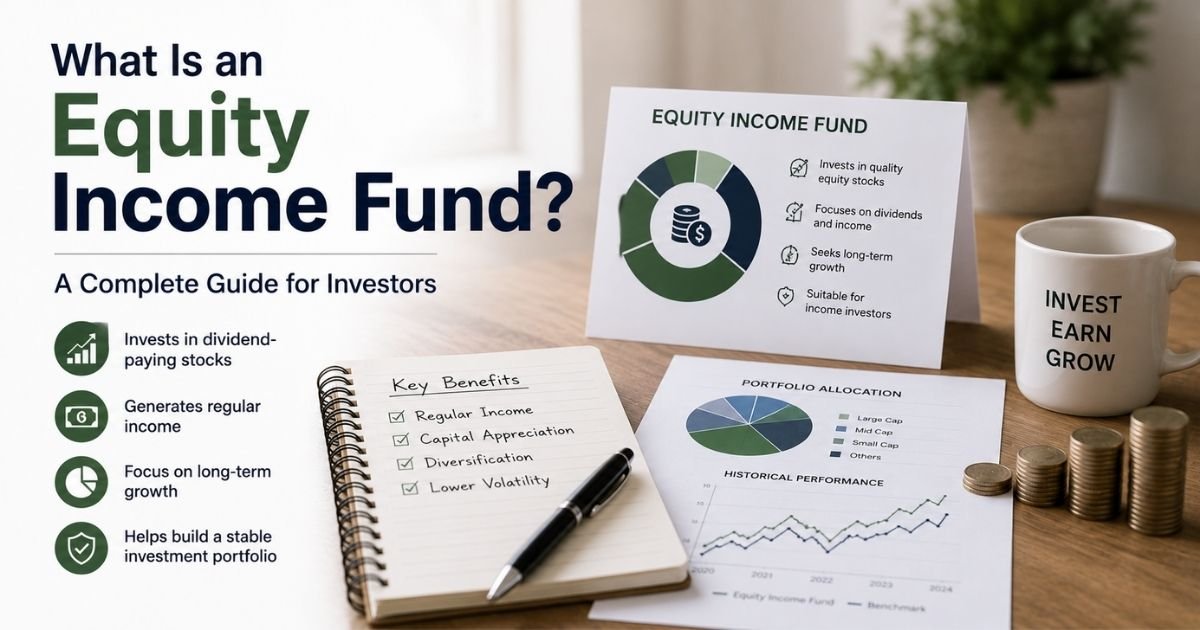
An equity income fund is a mutual fund or ETF that invests mainly in stocks that pay dividends. The goal is current income from those dividends, with some chance of share-price growth.
It is still a stock fund. The value can fall in a market drop. It is not a substitute for a savings account or a bond that promises a fixed coupon.
This article explains how these funds work, how they differ from growth funds and bond funds, how U.S. taxes usually apply, and what to check before you buy a share.
What Is an Equity Income Fund
What an Equity Income Fund Owns
“Equity” means stock. “Income” means the fund is built to collect cash from those stocks and pass much of it to you.
Typical holdings include:
- Large, established companies with a history of paying dividends
- Dividend-growth stocks that raise the payout over time
- Higher-yielding stocks in sectors such as utilities, consumer staples, energy, or financials
- Sometimes preferred stock or real estate investment trusts (REITs)
The manager or index screen looks for companies that can support a payout from earnings or cash flow. That screen often tilts the fund toward value-style businesses rather than fast-growing firms that reinvest every dollar.
A general “income fund” is a broader label. That category can hold mostly bonds, preferred shares, and only a slice of dividend stocks. An equity income fund is the stock-first version.
How the Fund Turns Dividends Into Your Check
The mechanics are straightforward.
- The fund buys a basket of stocks.
- Those companies pay dividends into the fund.
- After expenses, the fund distributes income to shareholders, often quarterly. Some funds pay monthly.
- You can take the cash or reinvest it in more fund shares.
When a fund pays a dividend, its net asset value (NAV) drops by about the same amount. You did not “earn extra” on top of the fund’s total value. You received a slice of value that was already inside the fund.
Total return is what matters over time:
Total return = change in share price + distributions
A fund can show a 3% yield and still lose money if prices fall more than 3%. A fund can also grow your income over years if the companies keep raising dividends and you reinvest.
You can hold these funds as mutual funds (bought from the fund company at NAV) or as ETFs (traded on an exchange like a stock).
Both can follow the same idea. ETFs often have lower minimums and trade all day. Mutual funds may have investment minimums and price once after the market close.
High Yield vs. Dividend Growth
Not every equity income fund chases the fattest current yield. The two common styles behave differently.
High-dividend funds screen for stocks with above-average yields today. The paycheck can look larger on day one. The risk is a “yield trap”: a stock yields 7% because the price already collapsed, and the dividend may be cut next.
Dividend-growth funds prefer companies that have raised dividends for many years. S&P 500 Dividend Aristocrats, for example, are index members with at least 25 straight years of increases. Starting yields are often lower. The bet is that a rising payout and a more durable business produce better total results.
Some funds blend both screens. Others add covered-call options to lift the cash distribution. Option income can raise the current yield and cap some upside when stocks rally. Read the strategy section of the prospectus so you know which engine is producing the “income.”
International equity income funds add foreign stocks. That can raise yield and currency risk. Emerging-market dividend funds add another layer of political and liquidity risk.
How These Funds Compare
| Feature | Equity income fund | Growth stock fund | Bond income fund |
|---|---|---|---|
| Main holdings | Dividend-paying stocks | Companies expected to grow earnings fast | Bonds and other debt |
| Typical cash source | Stock dividends | Little or none | Interest |
| Market risk | High (stocks) | High (stocks) | Lower than stocks, not zero |
| Inflation help | Possible if earnings and dividends rise | Possible if earnings rise | Weaker if rates and inflation jump |
| Who often uses it | Investors who want stock exposure plus cash | Investors focused on long-term growth | Investors who want more stable income |
An equity income fund sits between a pure growth fund and a bond fund. It will usually bounce around more than high-quality bonds. It may lag a growth-heavy market when investors favor unprofitable or low-payout technology names.
That mid-risk profile is why retirees sometimes use these funds for a portion of their stock allocation. It is also why they can disappoint people who thought “income fund” meant “safe.”
What Drives the Yield
Yield is not a guaranteed coupon.
Company boards can cut or suspend dividends when profits fall. Banks did this in the 2008 crisis. Energy firms did this when oil crashed. A fund that packed those names will see its distribution drop.
Interest rates also matter. When bond yields rise, some investors sell dividend stocks and buy Treasuries or CDs instead. Utility and REIT prices are often sensitive to that shift. The fund’s share price can fall even if every company keeps paying.
Sector bets matter too. If a large slice of the portfolio sits in financials or energy, one industry shock hits the whole fund. Check the top holdings and sector weights, not only the headline yield.
Fees reduce income. A fund that collects 2.5% in dividends and charges 0.80% in expenses has less to pay you than a similar fund that charges 0.08%. Compare the expense ratio and the 30-day SEC yield, which tries to show current income after expenses.
Taxes in a Regular Brokerage Account
In a taxable account, fund dividends are usually taxable in the year they are paid, even if you reinvest them.
U.S. tax rules split dividends into two buckets:
- Qualified dividends can be taxed at the long-term capital gains rates of 0%, 15%, or 20%, depending on your taxable income. Both the fund and you generally must meet holding-period tests.
- Ordinary (nonqualified) dividends are taxed at your regular income tax rate.
Form 1099-DIV reports the split. Box 1a is total ordinary dividends. Box 1b is the qualified portion, which is part of box 1a, not extra money. Capital gain distributions, if the fund sold winners, show up separately and are also taxed at capital-gains rates.
REIT dividends inside an equity income fund are often ordinary income, though a piece may be qualified or treated as return of capital.
Foreign-stock dividends may be qualified if the company meets IRS tests, or they may not. The fund’s year-end tax packet is the source of truth.
Holding the fund in a traditional IRA or 401(k) defers tax on dividends until you withdraw. A Roth account can make qualified withdrawals tax-free. That wrapper does not remove market risk.
The 3.8% net investment income tax can apply to dividends if your income is high enough. State tax rules vary.
Who an Equity Income Fund May Fit
These funds can make sense if you:
- Want stock-market growth potential and a cash distribution
- Prefer a diversified basket over picking individual dividend stocks
- Can hold through a bear market
- Plan to spend the income or reinvest it on purpose
They are a weaker fit if you:
- Need money that cannot fall in value next year
- Are stretching for a 7% to 10% stock yield without reading the holdings
- Already have a large slice of the same value sectors in other funds
- Will sell the first time the dividend is cut
You do not need an equity income fund to own dividend stocks. A broad total-stock-market fund already holds many dividend payers. The dedicated fund simply weights those names more heavily.
How to Evaluate a Fund Before You Buy
Use a short checklist.
- Objective. Does the prospectus say high current yield, dividend growth, or a mix?
- Holdings. Are the top names businesses you understand, or a cluster of stressed high yielders?
- SEC yield and distribution history. Has the payout been stable, rising, or lumpy because of special dividends and option premium?
- Total return. Look at 5- and 10-year results versus a plain large-value or S&P 500 benchmark, after fees.
- Expenses and turnover. High turnover can create extra capital-gain distributions in a taxable account.
- Share class. Investor, Admiral, Admiral-like, or ETF shares of the same strategy can have different costs.
Watch for funds that keep the distribution high by returning your own capital. Return of capital is not free income. It lowers your cost basis and can mask a shrinking portfolio.
A well-known example of the category is a large actively managed fund such as Vanguard Equity Income Fund (VEIPX), which focuses on U.S. companies with a record of dividends.
One published SEC yield for that fund was 1.96% as of May 31, 2026. That figure will move with prices and payouts. Use it as a reminder that equity income yields are often modest, not double-digit.
A Practical Way to Use One
If you add an equity income fund, decide the job first.
- For retirement spending, set distributions to cash and keep an emergency reserve so you are not forced to sell shares in a down year.
- For long-term growth, reinvest dividends and judge the fund on total return.
- For tax management, prefer the IRA for high ordinary-income slices (REITs, some foreign income) and compare qualified-dividend percentages in taxable accounts.
Rebalance if the fund grows into a larger share of your stocks than you intended. Dividend funds can quietly concentrate you in the same industries as a separate value fund.
FAQs About What Is an Equity Income Fund
Q. Is an equity income fund safer than the stock market?
A. No. It invests in stocks, so it can drop in a bear market. Dividend payers can be less volatile than high-growth names in some periods, but they are not bonds and they are not guaranteed.
Q. Do I still pay tax if I reinvest the dividends?
A. Yes, in a taxable account. Reinvested dividends are usually taxable in the year paid. They also raise your cost basis, which can reduce taxable gain when you later sell. Keep the 1099-DIV and year-end statements.
Q. How is an equity income fund different from a dividend ETF?
A. Many dividend ETFs are equity income funds in ETF form. A mutual fund version of the same idea buys and sells at NAV once a day. The investment style matters more than the wrapper.
Q. Can the fund cut what it pays me?
A. Yes. If holdings cut dividends, or if the share price rises faster than payouts, the yield can fall. Option-income funds can also pay less when market volatility drops.
Conclusion
An equity income fund is a stock fund built to collect and distribute dividends. It can add cash flow and a value tilt to a portfolio, but it still takes equity risk and can cut its payout.
If that mix matches your goal, compare yield, total return, fees, and tax character, then size the position as part of your stock allocation. Do not buy the fund only because the word “income” sounds safer than “stock.”
Disclaimer
This article is general educational information about equity income funds available to U.S. investors. It is not tax, legal, or investment advice. Yields, holdings, tax rates, and fund rules change. You can lose money in stock funds. Review the current prospectus, Form 1099-DIV instructions, and your own tax situation, and consider a licensed advisor before you invest.